Hi! Welcome to Milano's UpTowne Florist
Call us at : 614-889-1001
729 Mt. Airyshire Blvd.
Columbus OH 43235

Sympathy Flower Meanings: A Central Ohio Florist's Guide to Colors and Choices
White isn't the only right answer. Milano's UpTowne Florist explains what sympathy flower colors and flowers really mean, and how our Central Ohio design team helps families choose an arrangement that reflects the person they're honoring and remembering
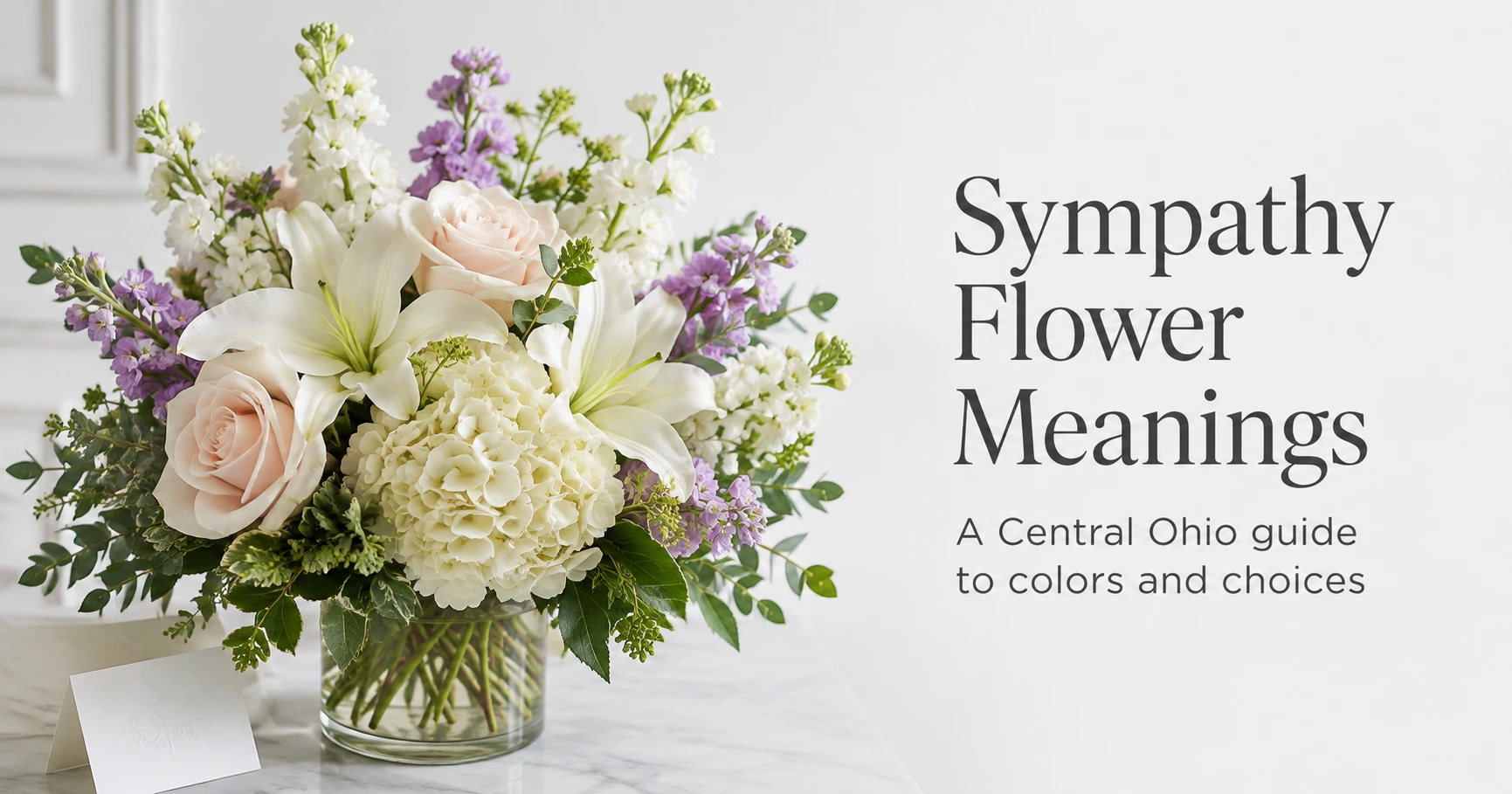
Sympathy flower meanings: a Central Ohio florist's guide to colors and choices
There is no single "correct" color or flower for sympathy. White has long been the traditional choice, and it carries real meaning, but it is not a rule you have to follow. When a family or friend comes to us at Milano's UpTowne Florist unsure of what to send, we usually start the same way: by talking about the person who passed, not by pointing to a chart of approved colors.
This guide is for anyone in Central Ohio trying to decide what to send for a loss, whether it is a coworker, a friend, or a family member. We will walk through what sympathy flower colors traditionally mean, what individual flowers represent, a few real arrangements our design team has put together, and a simple way to think through your own choice.
Buds & Blooms in brief: What do colors symbolize for sympathy flowers?
- White traditionally means purity and peace, but it is not the only appropriate choice. Purple represents dignity, pink represents grace and remembrance, yellow represents friendship and hope, and blue represents calm and trust.
- The biggest misconception about sympathy flower colors is that you have to stay soft and pastel. Bold, bright colors can be just as appropriate when they reflect who the person was.
- Lilies, roses, carnations, chrysanthemums, gladiolus, and orchids each carry their own traditional meanings, covered in detail below.
- Tall, structural flowers like snapdragons, larkspur, and stock give funeral pieces and standing sprays their height and shape.
- Arrangement style changes by destination: a funeral home or church service usually calls for a standing spray, while a delivery to a family's home is typically a vase arrangement. Color, though, stays tied to the person, not the venue.
- We offer same-day sympathy flower delivery across Central Ohio, including Columbus, Worthington, Powell, Dublin, Lewis Center, Delaware, Upper Arlington, and surrounding communities, when ordered by our daily cutoff.
What sympathy flower colors traditionally mean
Flower color symbolism has been passed down for generations, and it is still a useful starting point when you are not sure where to begin. These are the meanings most commonly associated with each color:
- White is associated with purity, peace, and innocence. It is the most traditional and most requested color for sympathy arrangements.
- Purple often represents dignity and admiration, which makes it a fitting choice when you want to honor someone's life and accomplishments.
- Pink is tied to grace, gentleness, and remembrance.
- Yellow is generally associated with friendship, warmth, and hope, and it works well for someone who was known for their bright personality.
- Red represents deep love and respect, and in darker shades it can also express grief itself.
- Blue is often connected to calm, trust, and peacefulness, and it has become a popular accent color in sympathy work.
You will see these meanings referenced often, and they are a helpful place to start. But in our experience, they work best as a guide, not a requirement.
The biggest misconception about sympathy flower colors
The most common misconception we run into is that sympathy flowers have to stay soft: whites, pastels, and muted purples, and nothing else. That simply is not true. We have designed patriotic red, white, and blue tributes for veterans. We have built bright, energetic arrangements for people who were anything but soft-spoken. There is no strong case for one approach over the other. It comes down to the person being remembered and what the sender wants that arrangement to say about them.
How we help someone choose
When a customer calls or comes into the shop without a clear idea of what to send, we do not start with color swatches. We start with questions about the person:
- What was your relationship with the person?
- What was the person like? Were they cheerful and bubbly, or more soft-spoken and understated?
- Did they have a favorite flower or color that comes to mind?
- Is there anything you remember about them and flowers specifically?
The answers usually point us toward a palette on their own. A family remembering someone lively and social often gravitates toward brighter colors. A family honoring someone gentle and reserved often leans toward a softer, more muted palette. Neither one is more appropriate than the other.
Real sympathy arrangements that told a story
All white with a touch of blue
A family recently came to us wanting an all-white sympathy arrangement, but with a touch of blue worked in. It is a simple request, but it is a good example of how even a traditional, classic palette can be personalized. We were able to customize the design around that detail rather than handing over a standard all-white piece.
Bright colors and drumsticks for a musician
Not long ago, a customer came in for a family member who had played in a band. They wanted bright, vibrant colors, and we incorporated drumsticks directly into the arrangement. When someone thinks of a musician or a drummer, they think vibrant and exciting, not soft and quiet, so that is what the arrangement became. It is one of our favorite recent examples of a sympathy piece that genuinely reflected who someone was.
Common funeral and sympathy flower meanings
Beyond color, individual flowers carry their own traditional meanings. These associations vary somewhat by source and culture, but here are the meanings most commonly attached to flowers we use often in sympathy work:
- Lilies, especially white ones, are traditionally associated with the restored innocence of the soul, which is part of why they are so closely tied to sympathy and funeral arrangements.
- Roses carry different meanings by color: red for love and grief, white for innocence, yellow for friendship, and pink for remembrance and gratitude.
- Carnations are often tied to lasting love and remembrance, with white representing innocence and pink often carrying a more sentimental, personal meaning.
- Chrysanthemums are associated with truth and honesty in the United States, though it is worth noting they carry a different, more somber meaning in some other cultures.
- Gladiolus is tied to strength of character, integrity, and sincerity, which makes it a natural fit for honoring someone's life.
- Orchids, particularly white and pink varieties, are associated with everlasting love and are often given as a lasting plant rather than a cut arrangement.
Why funeral pieces often lean on tall, structural flowers
If you have ever looked closely at a standing spray or a larger funeral piece, you have probably noticed flowers like snapdragons, larkspur, and stock worked throughout. Part of that is practical: funeral pieces tend to be larger, and taller, longer-stemmed flowers give a design the height and structure it needs. But there is a nice bit of symbolism layered in as well. Larkspur is traditionally tied to strong bonds of affection, snapdragons are associated with strength, and stock is linked to a full, contented life, which happens to fit the purpose of the arrangement itself.
Matching flowers to the person, not a formula
We tend to see some general patterns in what people request. For a woman, families often lean toward softer colors and more muted tones. For a man, it is common to see blues, whites, yellows, and touches of light green worked in for a more understated, masculine feel. These are tendencies we notice, not rules we apply. As we tell customers often, it is not about us as the florist. It is about what the sender wants the arrangement to represent about the person they lost.
Does the delivery location change the flowers?
The destination changes the style of the arrangement more than it changes the colors. Flowers going to a funeral home or church service tend toward a more traditional design, such as a standing spray, since that format is built for a service setting. Flowers going to a family's home are typically designed as a vase arrangement, which fits more naturally into a living space. The color palette, though, stays tied to the relationship and the person, not the venue.
Choosing sympathy flowers on a tight timeline
Sympathy needs often come up quickly, and we understand that. Even with a same-day request, our design team can still put together something that feels meaningful rather than generic. We offer same-day delivery across most of our Central Ohio service area, including Worthington, Powell, Dublin, Lewis Center, Delaware, Upper Arlington, Westerville, Hilliard, Plain City, Clintonville, and the surrounding communities, when ordered by our daily cutoff. If something specific is on your mind, our team is happy to talk through it with you by phone.
A simple framework for choosing sympathy flower colors yourself
If you want to work through this on your own before calling a florist, ask yourself the same questions we ask in the shop:
- What was your relationship with the person?
- What was their personality like: bright and outgoing, or calm and quiet?
- Is there a flower or color you remember them loving?
- Where is the arrangement going: a service, or a family's home?
Once you have honest answers to those questions, a color palette usually starts to feel obvious.
Frequently asked questions
Do sympathy flowers have to be white?
No. White is the most traditional choice and is often associated with purity and peace, but it is not a requirement. Many families choose soft pastels, bold colors, or a color the person loved instead. What matters most is that the arrangement feels true to the person being remembered.
What does the color purple mean in sympathy flowers?
Purple is generally associated with dignity and admiration, which is why it is a common choice when you want to honor someone's life and accomplishments. It pairs well with white, pink, or blue in a sympathy design.
What flowers are traditionally used for funerals?
Lilies, roses, carnations, and chrysanthemums are among the most common, each with its own traditional meaning. Taller, structural flowers like snapdragons, larkspur, and stock are also frequently used in standing sprays and larger funeral pieces because they hold their height and shape well.
Can I send bright or colorful flowers for a sympathy arrangement?
Yes. Bright, cheerful colors can be just as appropriate as soft pastels, especially when they reflect the person's personality or interests. We have designed sympathy arrangements in bold colors and even worked in personal touches, like drumsticks for a family member who was a musician.
How do I decide what to send if I am not sure what the family would want?
Start with your relationship to the person, their personality, and whether a favorite flower or color comes to mind. If nothing comes to mind right away, our design team is glad to walk through a few questions with you over the phone and put something meaningful together.
Do sympathy flower meanings differ by culture or tradition?
Flower meanings can vary somewhat by culture, so it is worth keeping that in mind if you know the family's background. In our day-to-day work, most Central Ohio families focus less on strict symbolism and more on choosing something that reflects the person they are honoring.
Do you deliver flowers to funeral homes?
Yes, we deliver flowers to funeral homes, churches and homes every day. We work closely with the funeral home staff to make sure your flowers arrive in time for all services. We deliver to Schoedinger, Rutherford, Newcomer and all of the funeral homes in Central Ohio. You can see our complete list on our funeral home flower guide.
Sending flowers that reflect who they were
Sympathy flower meanings are a helpful starting point, not a strict set of rules. Milano's UpTowne Florist has been part of Central Ohio's flower traditions since 1935, and our design team talks through these choices with families throughout the year. If you would like help choosing colors and flowers for someone you are remembering, call us at 614-889-1001 or order online, and we will help you put together something that feels right.